 |
| European cemetery Ambala Cantonment facebook.com |


As the British ruled India for a pretty long time (until 1947), there are many European grave yards in the cities like Kolkata (Calcutta), Chennai (Madras), Delhi and other places where a large European community lived and the British army had a barrack or a cantonment. These Europeans came to India for jobs with the English company later the Crown. There were countless soldiers, business people and missionaries. The latter landed here with a view to spreading Christianity among the natives and built churches and schools for Indians and Europeans. The European cemeteries in India, a legacy of the British empire, remind us of what John Donne, a 16th century metaphysical poet once described 'death' as the greatest leveler in his masterpiece 'Death', Be Not Proud. ''The paths of glory lead but to the grave''
 |
| Christian cemetery, Ambala, Haryana. tourmet.com |
The presence of a European graveyard in Ambala Cantonment, Haryana state was a surprise. It was brought to light during the independence time in the past. The European Cemetery built in 1902 in typical British architecture, is now a protected monument of the state. Ambala Cemetery Committee and the Secretary of the Committee - the Parish Priest of Holy Redeemer Church (Catholic Church) were in charge of maintaining this historic site that
spreads across 23 acres. It is believed to be the biggest burial ground in the northern region with more than 2 lakh. “The discovery of the cemetery is significant as some British soldiers and even prisoners from the Second Anglo-Boer War are buried there,” said an officer Madhav Acharya.
Many of the graves were built in European style with cubic and rectangular domes over the burial ground. The entrance of this grave has two large cylindrical pillars with triangular dome on it. There are also obelisk structures and it is said, they were meant for the higher officials served for British India. A simple cement structure with a cross is seen in the graves of prisoners of war (POWS) and soldiers. The entrance of this grave is built with two large cylindrical pillars with triangular dome on it. The graves here are the war heroes of Africa, British soldier's prisoners of war and its company officials. It is located in the Cantonment Area, Jagadhri Road, Ambala City. There are 20 boer graves here.
It is observed that most of the grave blocks here are made of granite stones, clay bricks, sand stones and few are placed with marble stones. Cross made of cement and jelly stones are found in the burial place of the common people. The marble stone plaque has encryption of the blessed souls who were buried here. St Paul's Church of Roman Catholic order, takes care of the rituals associated with the blessed ones.
spreads across 23 acres. It is believed to be the biggest burial ground in the northern region with more than 2 lakh. “The discovery of the cemetery is significant as some British soldiers and even prisoners from the Second Anglo-Boer War are buried there,” said an officer Madhav Acharya.
Many of the graves were built in European style with cubic and rectangular domes over the burial ground. The entrance of this grave has two large cylindrical pillars with triangular dome on it. There are also obelisk structures and it is said, they were meant for the higher officials served for British India. A simple cement structure with a cross is seen in the graves of prisoners of war (POWS) and soldiers. The entrance of this grave is built with two large cylindrical pillars with triangular dome on it. The graves here are the war heroes of Africa, British soldier's prisoners of war and its company officials. It is located in the Cantonment Area, Jagadhri Road, Ambala City. There are 20 boer graves here.
It is observed that most of the grave blocks here are made of granite stones, clay bricks, sand stones and few are placed with marble stones. Cross made of cement and jelly stones are found in the burial place of the common people. The marble stone plaque has encryption of the blessed souls who were buried here. St Paul's Church of Roman Catholic order, takes care of the rituals associated with the blessed ones.
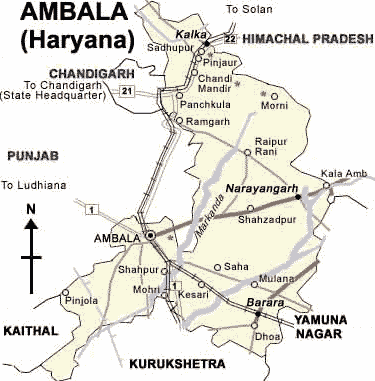 |
| Location map Ambala, Haryana. jatland wiki |
This European cemetery was established in the 19th century by the English mercantile trading Company - East India company who by that time, had captured many parts of India through dishonest means and manipulation. This grave was built in the wake of the great Anglo Boer War of 1880 -1881 AD and 1899 to 1902 AD fought in the South African countries. The war broke out between the British Empire and Bore Farmers who had been living there for a long time. Lots of British soldiers were killed in these wars and the British captured the revolting rebels in large numbers and sent them to colonies like Sri Lanka, India, etc. Lots of rebels from Africa were imprisoned in Ambala, and later executed and buried in the graveyard. Similarly many Boer farmers and Africans who were unable to return home were buried here.
 |
| European cemetery Ambala Cantonment tripadvisor.in |
During the Independence time, one British officer came to Ambala to pay homage to the great 'British War heroes' of Anglo Boer War. Then only the Indian media and others came to know of the presence of a European graveyard here that included Boer farmers of Africa. After Independence, the Roman catholic church took care of the rituals and now manages it with the ASI.
This grave is a reminder of memories of Anglo Bore War held fought in South Africa. This place comes under Large Grave category of European Colonial Era in the tourist chart of Haryana tourism. Yet another historical importance is the grave is the final resting place of the last EIC and their families. (A revised Version)
K. N. Jayaraman (Author: navrangindia.blogspot.com )

.jpg)


