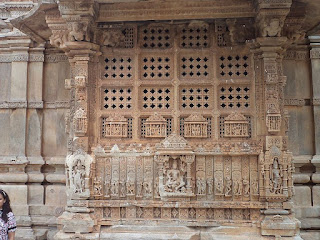
Above image:2. Jali wall, Ajinatha Temple, Taranga, Gujarat, 11th century, Photo: Anand Patel 3. Seven-Jali wall, tomb of Akbar, Sikandra,1613, Photo: Abhinav Goswami 4. Gateway of India, Mumbai, 1915, Photo: Shutterstock 5. Jami Masjid, Champaner, Gujarat, 1523, Photo: Abhinav Goswami. From Jali: Lattice of Divine Light in Mughal Architecture(Mapin).......The jāli, a perforated stone or wooden lattice screen, is one of the most ingenious elements developed in the architectural traditions of India. In the hot tropical climate of the subcontinent, where summers are intense and often humid, jālis served as natural regulators of temperature, light, and ventilation long before the advent of modern cooling systems. Their multi-functional nature made them indispensable in Hindu temples, palaces, and later in Indo-Islamic structures.
From a climatic perspective, the jāli works on simple physics. Air passing through small perforations gets compressed and released, causing a cooling effect similar to evaporative or passive air-conditioning. The increase in air velocity through the narrow openings ensures effective airflow indoors. This makes jālis suitable for both hot–dry zones like Gujarat and Rajasthan, and humid regions like Kerala and the Konkan. In moist coastal climates, larger perforations with less opacity were preferred, whereas arid regions favoured denser patterns that minimized heat gain. The size, depth, and spacing of the holes were therefore carefully customized to regional climate requirements.
The jāli creates an ideal indoor environment by allowing abundant ventilation, cutting glare, reducing heat ingress, and producing a soft, diffused light suitable for sacred spaces. Hindu temples, where the garbhagriha remains dim to evoke a cave-like sanctity, required the adjoining mandapas to be lit without harsh sunlight. The recessed jāli window achieved this perfectly, maintaining illumination while eliminating direct beams, haze, and glare. Rainwater too was kept out due to the depth and inward slope of the perforated panels.
Another unique advantage of the jāli is the privacy it offers. Because of the difference in light intensity, devotees inside can view the outside world clearly, while the interior remains concealed from external gaze—an important feature in temple complexes and palaces.
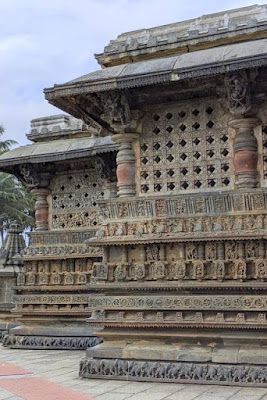
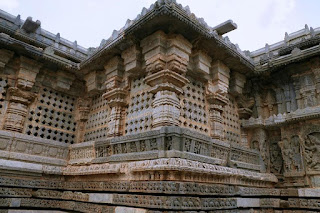
Architecturally, jālis were seamlessly integrated into temple walls, corridors, vestibules, and entrance porches. They were carved as monolithic stone slabs or assembled from wooden units, often strengthened with horizontal and vertical struts to prevent sagging. The earliest stone jālis appear in Gupta-period temples such as the Parvati Temple at Nachna and the Mundeshwari Temple in Bihar. By the 10th–12th centuries, they reached exceptional refinement in the Mukteshwar Temple at Bhubaneswar, the Chalukya monuments at Aihole and Lakkundi, and the Hoysala temples of Belur and Halebidu, where soapstone allowed deep, crisp carving. Chola temples like the Airavatesvara Temple at Darasuram also employed beautifully pierced screens along outer mandapa walls.
Although Mughal architecture popularized the jāli in marble and red sandstone, the concept itself belongs firmly to ancient Hindu and Buddhist traditions dating back over 1,500 years. In modern times, architect Laurie Baker revived the jali in Kerala, demonstrating its continued relevance as a sustainable, climate-responsive building element. Jaalis also differ in their performance in different climates, based on the screen design, geometries, perforation, form and materials being used. There is no one-size-fits-all solution. Jaali screens where 30% is made up of holes with a depth of 10cm (4in) achieve a better thermal comfort in a hot-arid climate, for example. In hot-humid climates, the perforation ratio may need to be. Despite these limitations, jaali helps create energy-efficient buildings by providing natural lighting and ventilation.
The British too were inspired by jalis. The jali was not a major feature in the architecture of the Raj but you can see interesting ones in Rashtrapati Bhavan, which combined old and new influences into distinctive styles such as lyres or star nets. Architect Laurie Baker was the one who popularized the use of Jali in modern architecture based on his experience in Kerala.
 |
Darasuram temple. .shutterstock.com
|
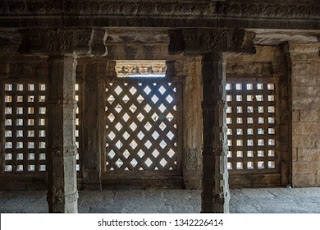
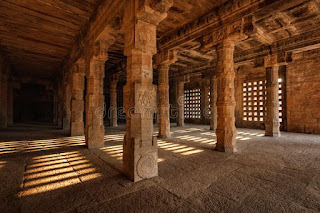
Above images: Darasuram temple, near kumbakonam, Tamil Nadu. 12th century CE Shiva temple (Airavatesvara) a unesco WHS. . Jali on the outer wall from inside.The diffusion of air occurs because of increase in velocity when passing through small holes in the jali-lattice screens. So, there is a good penetration of air indoors.Jali provides good ventilation, filters the sunlight and increases the movement of cross air findoors.............
Above image: Chennakesava temple, Belur, Karnataka: Part of perforated store screen - Jali on square plan. Horizontal friezes ( a horizontal band -sculpted or painted work on the wall ) on the base of wall all around. Jali proves to be effective in hot dry and humid climate zones. Humid areas like Kerala and Konkan have larger holes with less opacity than in the case of dry climate regions of Gujarat and Rajasthan........
Above images:
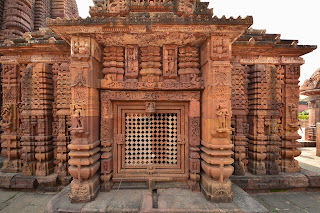
Jali- perforated windows in Mukteswar temple. Odisha. Dedicated to God Shiva, this beautifully ornamented Hindu temple was built in way back in 950 CE by Soma Vamshi dynasty. The recessed jali window does not allow rains to enter the temple
. .........Above image: Perforated windows, North East wall, Kedareshwara Temple, Halebidu, Karnataka India; constructed by Hoysala King Veera Ballala II (r. 1173–1220 A.D.) and his Queen Ketaladevi,
Kedareshwara Temple is dedicated to God Shiva.........
 |
| Kedareshwara Temple, Halebidu.KA upload.wikimedia.org |
Above image: Interior of Kedareshwara Temple, Halebidu. KA dedicated to god Shiva. look at the lathe turned pillar and the jali- stone perforated scree on the side. Mainly soap stone is used to come up with intricate carvings of superb quality- roughly 1000 years ago.
 |
| Jali perforated stone window, Manikesvara Temple |
l
ouringwithpk.com
 |
stone window screen Manikeswari Temple in
|
Above images: A pierced window screen brings light into the mantapa at Manikesvara Temple in
Lakkundi - 12th century Western Chalukya temple, Karnataka. Look at the stone jali at the entrance.
The design style and hole size in jalis may vary depending on the climate of region
Aihole in the Deccan. In the latter monument, timber-like sandstone jalis on the 3 sides of the walls to illuminate the hall, Siva is impaling a victim..........
 |
Jali window, kopeshwar, MH
|
|
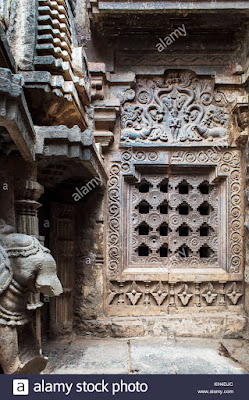
Above image: Top image - Jali perforated windows in the temple entrance of kopeshwar temple, Khidrapur, Kolhapur district, Maharashtra. bottom image; stone jali on the wall on the side. The temple was built in the 12th century by Shilahara (Shelara) king Gandaraditya between 1109 and 1178 CE to the east of Kolhapur, on the bank of the Krishna river...........................
 |
Hindu temple in Kathmandu
 | | Ladkhan temple with floral jali .istockphoto.com |
|
|
Above Image: : The Hindu temple dated dated to the 7th or 8th century.
......... Above image: Perforated stone window at Parvati Temple at Nachna-Kuthara. Panna dist. MP. dated to the 5th- or 6th-century Gupta era.
It is quite obvious that jali or perforated stone window concept was conceived way back in the 5th century CE as part of the Hindu temple architecture. In the case of Buddhist temple i the concept was prevalent in the western ghat of the Deccan in the 2nd century itself ; they used teak wood to make Jali and fixed the screens above the arched entrance. Positively, The concept of jali or perforated screen was not first introduced in India by the Moguls and this utility-based concept had been in across India for centuries before their arrival. No doubt moguls came up with striking designs , added aesthetics to their Indo-Islamic architecture/ and popularized the use of jali in various buildings- palaces, mosques mausoleums, etc. They preferred marble or sandstones for carving eye-catching designs. Reposted with corrections from https://navrangindia.blogspot.com/2022/07/stone-jali-lattice-windows-of-hindu.html







.jpeg)