 |
| winni.in |
"Happy Rama Navami greetings to all"
Ram Navami, one of the auspicious Hindu festivals was celebrated with devotion on the 27th of March - yesterday, marking the commemoration of the birth anniversary of Lord Rama, the seventh avatar of Lord Vishnu. This festival is also known as Shri Ram Janmotsav and devotees across India visit the nearby Sri Rama temple to get his blessings. Rama Navami falls on the last day of the nine-day fast of Chaitra (Shukla Paksha) Navratri.A visit to the temple or prayer will help devotees to pursue the path of truth and uphold their moral ideals.
As part of Rama Navami Celebration two lesser known Sri Rama temples of Tamil Nadu will be covered,one is at Punnainallur (Mariamman Kovil near Thanjavur city and the other being at Ayodhyapattinam near Salem city. Each will be in a different post.
Nestled just seven kilometers east of the historic city of Thanjavur, near the famous Punnainallur Mariamman Temple, lies a hidden architectural and spiritual gem: the Sri Saligrama Kothandaramar Temple. While Thanjavur is globally renowned for its Chola-era Brihadisvara Temple, this sacred site offers a unique glimpse into the later patronage of the Maratha rulers, specifically King Pratap Singh, who reigned in the 18th century.
 |
Kothandaramar temple,Mariamman kovil,
(Punnainallur)TN image P.Jambulingam en.wikipedia.org |
 |
Kothandaramar kovil, Mariamman kovil,
Tamil Nadu,I.anudhinam.org |
Above image: Sri Kothandaramar temple, Mariamman Kovil. Thanjavur, Tamil nadu. This temple is famous for 1400 year old metal idols (an alloy of five metals) of Sri Rama, Seetha & Lakshmana, and large Saligrama deities in the sanctum. largest Salagrama stone images in India.The Vimana in the sanctum is called Soundarya Vimanam................
 |
| Kothandaramar kovil,Mariamman kovil,(Punnainallur) |
TN mage P.Jambulingam en.wikipedia.org |
Historical Origins and Royal Patronage
The temple’s history is a fascinating blend of regional politics and trans-continental devotion. It was established by the Maratha King Pratap Singh, a prolific builder who sought to enrich the Thanjavur region’s religious landscape. A compelling piece of history associated with the temple involves the King of Nepal, who was the son-in-law of the Thanjavur Maratha King. As a gesture of high spiritual regard, the Nepali monarch presented massive, holy
Saligrama stones to the Thanjavur court. Recognizing their immense sanctity, the King commissioned these stones to be carved into the majestic deities that grace the temple today.
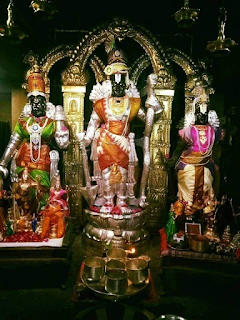 |
Kothandaramar kovil, Mariamman kovil,
idols. tamilbrahmins.com |
The Unique Saligrama Moolavar
The primary distinction of this temple is its Moolavar (presiding deities) in the sanctum /
garbhagriha. It is arguably the only Rama temple in India where the central figures—Rama, Sita, Lakshmana, and Sugreeva—are entirely carved from Saligrama stone. Typically, Saligramas are found as small,
naturally occurring ammonite fossils in the
Gandaki River of Nepal and are worshipped in their spherical form. At this temple, however, the stones were large enough to be fashioned into standing idols approximately six feet tall. These black, fossilized stones are considered "anionic" representations of Lord Vishnu, imbuing the sanctum with a potent, ancient energy under the Soundarya Vimanam.
 |
Saligrama stones of the Tethyan sea
Nepal. |
Saligrama stones are fossilized forms of Ammonites that lived hundreds of millions of years ago in the shallow water of the huge ancient sea called "Tethys" The black colored fossils are found in the sacred River Gandaki, Nepal. The fossils were formed in the sediments in the ancient sea which is now occupied by the Himalayas that arose later (Himalayan orogeny) ..........
Beyond the stone carvings, the temple houses Urchavar (processional) idols of extraordinary antiquity. These metal icons of Rama, Sita, and Lakshmana are made of
Iyempon—a traditional five-metal alloy (Ashtadhatu variant)—and are estimated to be 1,400 years old. Their delicate features and strikingly beautiful craftsmanship represent a bridge between the ancient metallurgical traditions of the
post-Gupta/early Pallava era and the later Maratha sanctuary.
Current Status and Atmosphere
Today, the temple remains a serene destination for those seeking a quiet alternative to the bustling city shrines. The corridors are adorned with recent, vibrant wall paintings depicting the
Ramayana, which contrast beautifully with the ancient stone structures. Alongside the main sanctum, there are smaller shrines dedicated to Sudharsana and Anjaneyar. Managed with care, the temple stands as a testament to the cultural synthesis of the Marathas in Tamil Nadu, preserving a rare intersection of Himalayan geology and Dravidian devotion.
The renowned Punnainallur Sri Mariamman temple that was established by Sri Sadasiva Brahmendra, a great saint of past era is just near by, Both Kothandaramar Temple and Punnainallur Sri Mariamman temple are being managed by the
Thanjavur Aranmanai Devasthanam headed by the present Maratha Prince.
K. N Jayaraman & N. Srikantan


