 |
| Trikkur Mahadeva temple. alayamkanden.blogspot.in |
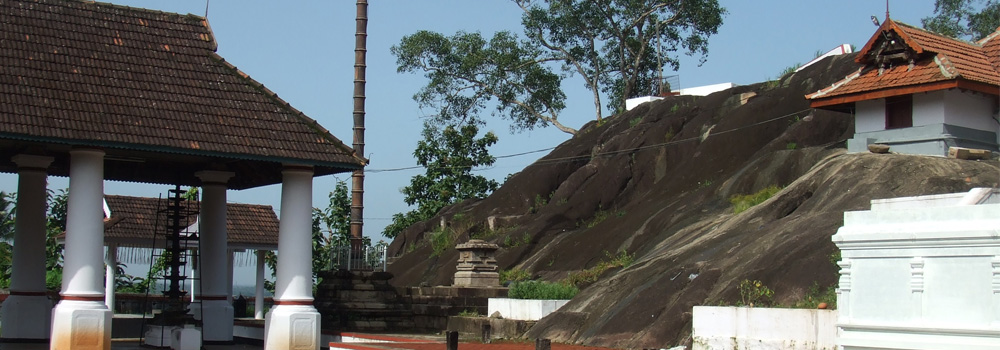
The Trikkur Mahadeva temple in the small town of Trikkur on the banks of the Manali River is located about ten kilometer from Thrissur city and the temple complex is about 200 meters above the MSL. It is one among the oldest and very few rock cut Shiva temples of Kerala where the lord is in Swayambhu form - self-manifested. The idol is about 6 feet tall.
 |
| Trikkur-mahadeva temple aalayamkanden.blogspot.com |
 |
| Trikkur-mahadeva temple manoramaonline.com |
 |
| Trikkur-mahadeva temple . Kerala tourismeveryone.com |
 |
| Trikkur Mahadeva temple,Kerala.tourismeveryone.com |
The entrance to the temple complex consisting of many mantaps is accessed through a flight of steps to get to the higher elevation. It is a typical rock-cut cave temple with Sreekovil (sanctum) inside the cave and it is twelve feet long and eight feet wide. It opens out towards the north. The Murgha mantapa, in front of the sanctum, is large and is carved fully out of rock. The main deity faces the east, but for the Darshan, the devotees are allowed to see only the right side of the Linga.(‘Parshwa Darshan”). Additions include Nada with steps leading to the main shrine and Artha Mantapa. Ganapathy, Sapthamatrika and other shrines atop the hill can be reached, using separate set of rugged rock steps. The temple has a dwajasthambam (flag-post) as in other Hindu temples and also a prakaram (Corridor) around the main shrine where one can find small shrines dedicated to different gods.
 |
| Mugha mantap, Mahadev temple alayamkanden.blogspot.in |
Here lord Shiva is symbolic of fire (agni), one of the Pancha Boothas (five essential elements). The belief has been that Agni eternally resides in this shrine, hence the procession of the deity is not allowed outside the temple (Ezhunnallathu) on rainy or cloudy days. This tradition is not followed in many temples. Here, the lord's consort is Parvati. As for lord Ganapathy, one can see the carved image on the wall of the cave (west side). The two Dwarapalakas in the Murgha mantap are the sentinels, guarding the shrine and the deities. There is a Namaskara mantap (here devotees prostrate before the lord) adorned with many beautiful carvings. This cave temple has a separate mantap (hall) where Saraswati puja is held annually. In the same mantap, during festival times such as Navaratri or Shivaratri, Chakyar Koothu-dance drama, an integral part of Kerala's culture is conducted with religious fervour in front of a large audience.
 |
| Trikkur Mahadeva temple, Kerala blogger.com |


