 |
| Lord Elgin memorial, St.Paul Cathedral,Kolkata victorianweb.org |
 |
| Viceroy Elgin, Victoria.web.co |
In the quiet, hallowed narthex of St. Paul’s Cathedral, Kolkata, stands a monument that is as much a testament to the global reach of the British Empire as it is to the "robust synthesis" of Victorian art. Dedicated to James Bruce, the Eighth Earl of Elgin and Viceroy of India (1862–63), this cenotaph is an unusual and significant example of colonial funerary art, marking the legacy of a man whose career spanned the continents of the 19th-century world.
 |
| St.Paul Cathedral, Kolkata en.wikipedia.org |
_-_1865%20(1).jpg) |
| 1865 St.Paul Church,Calcutta (Kolkata) image: Samuel Bourne en.wikipedia.org |
History and Collaborative Origin
Lord Elgin’s viceroyship was tragically foreshortened; he died in 1863, only eighteen months into his tenure, while touring the North-West Frontier. He was buried at St. John in the Wilderness Church in Dharamshala, but the British Raj commissioned a grand memorial for the Anglican cathedral in the capital, Kolkata. Completed in 1869, the monument was the result of a "fruitful collaboration" between two giants of Victorian design: the architect Sir George Gilbert Scott and the master craftsman John Birnie Philip. Both men were famous for their work on the Albert Memorial in London, and they brought a similar level of "sumptuousness" to this Indian commission.
 |
| Tomb of Elgin,St. John's church Dharamshala, HP. commons.wikimedia.org |
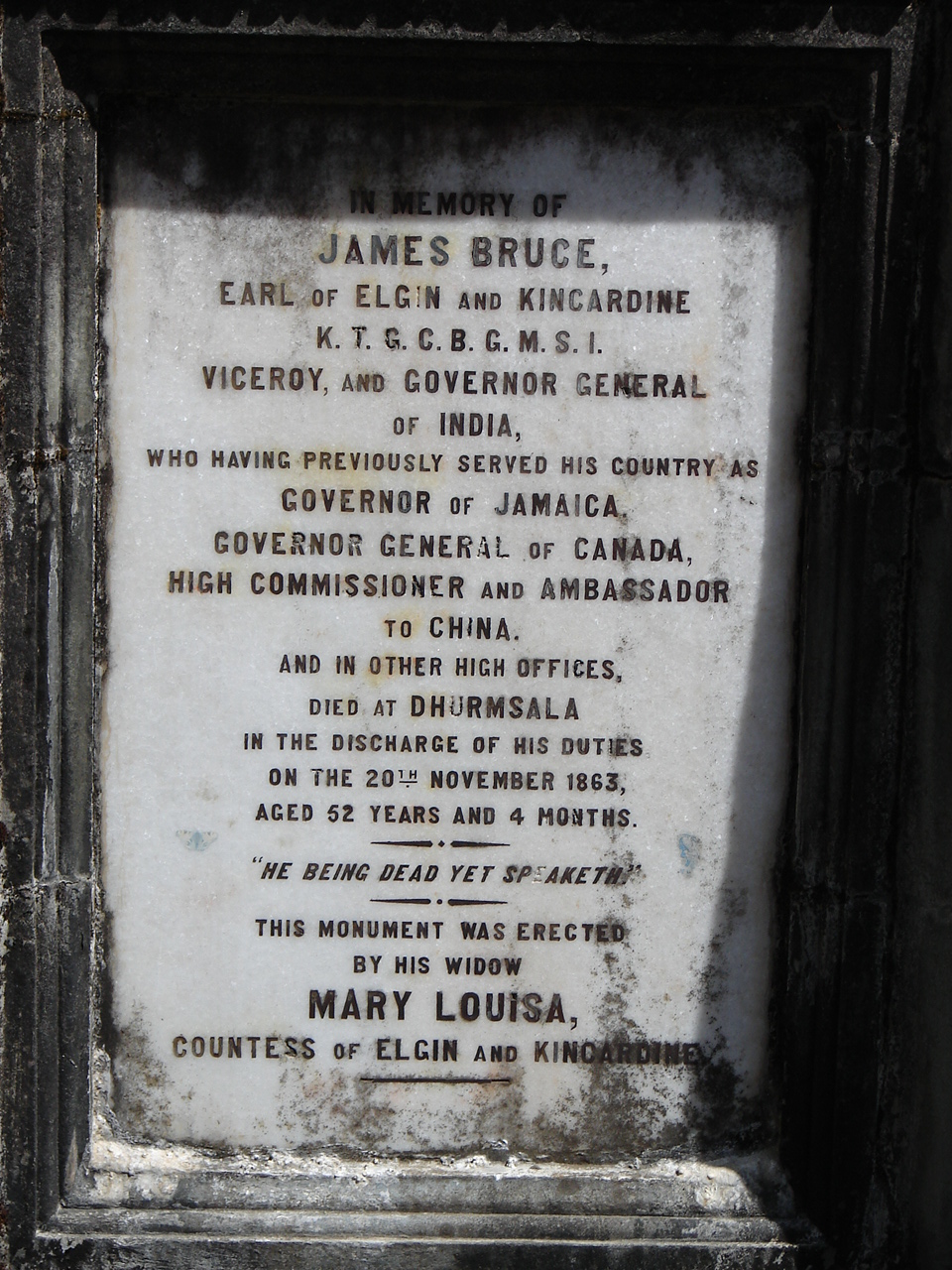 |
| Lord Elgin memorial, Dharamshala. upload.wikimedia.org |
 |
| St. John's church Dharamshala, HP. tribuneindia.com |
 |
| St.Paul Cathedral, Kolkata elginhotels.com |
Artistic Features and Symbolism
The monument takes the form of a Gothic tomb-chest or cenotaph. It is rich in material and texture, blending stone-carving with intricate metalwork. At its apex sits a small but strikingly accurate marble portrait of Lord Elgin. Below this, the monument features an inlaid brass cross and the Elgin family motto: "Fuimus" ("We Have Been"), signifying a legacy that has left an indelible mark on history.
The most distinctive feature, however, is the set of four bronze bas-reliefs set in quatrefoils. These panels serve as a visual biography of Elgin’s high offices across the British Empire:
 |
| Elgin Bas-relief.Jamaica victorianweb.org |
Jamaica: Depicts a sugar plantation, showing the colonial economy and the interaction between planters and workers.
.jpg) |
| Elgin Bas-relief Canada victorianweb.org |
Canada: Illustrates the frontier life, featuring settlers felling trees alongside Indigenous families and Inuit figures.
 |
| Elgin Bas-relief China victorianweb.org |
China: A rare historical depiction showing Elgin negotiating with a Mandarin official, with the Great Wall visible in the background.
 |
| Elgin Bas-relief work St.JohnCathedral Kolkata, WB victorianweb.org |
India: Significantly depicts a military encampment with sepoys and an elephant, representing the administrative and military weight of the Raj.
Architectural Significance
Historians note that this monument is an "exception" to Scott’s typically English Gothic style. Here, Scott explored Italian Gothic and Byzantine influences, encouraged by the theories of John Ruskin. The blurring of boundaries between architecture and sculpture, the use of mixed media, and the incorporation of global geographical themes suggest that Scott’s artistic vision was far broader than his critics often allowed.
Historical Significance and Present Condition
The Elgin monument is more than a funerary marker; it is a "geographic map" of 19th-century British diplomacy. It commemorates a man who served in the Caribbean, North America, and East Asia before reaching the pinnacle of the Indian Viceroyalty.
Today, the monument remains in the vestibule of St. Paul’s Cathedral, Kolkata. While the cathedral itself is a bustling center of heritage and worship, these monuments in the narthex—including the similar one to Colonel Richard Baird Smith—continue to offer a window into the high-Victorian aesthetic. They remain well-preserved examples of how the British sought to immortalize their "imperial heroes" through a blend of European artistic sophistication and the narrative of global governance.
https://navrangindia.blogspot.com/2023/04/st-johns-church-dharamshala-hp-and.html
ttps://www.elginhotels.com/st-pauls-cathedral-kolkata
https://fabdiz.com/st-pauls-cathedral-a-symbol-of-kolkatas-colonial-past/
https://victorianweb.org/sculpture/philip/16.html
https://kevinstandagephotography.wordpress.com/2024/10/29/st-pauls-cathedral-kolkata
K. N. Jayaraman (Author: navrangindia.blogspot.com)


