 |
| Corrupt practices. .cartoonstock.com |
 |
| /halelrod.com |
We have to go on a short nostalgic trip down the memory lane to the early colonial days of Madras (now Chennai,Tamil Nadu state) then called Chennapatna. Indian Agents locally called Dubhasis played a key role between the English Sahibs (Durai in Tamil) and the native rulers and merchants in their daily interactions with respect to business dealings, etc. Gradually the Indian agents as consented by the officials made an inroad into the corridors of power and political affairs in Fort St. George, Madras because of their long and close acquaintance with higher-ups like the Governors, etc. It is imperative that their dedicated services as interpreters or agents or translators for the English officials and merchants could never be ignored. Rather, the officials relied heavily on them for better administration, implementation of civil projects, purchase of commodities, etc. The officials needed the cooperation of the local population and could approach them only through dubashis. No political and commercial agreements with local rulers or others could be possible for the English without their help and advice. Including low-ranking English officials, powerful local traders and contractors could access the Governor or any other higher-ups in the saddle of power only through them. They had unquestionable authority and power within the confines of Fort St. George.
 |
| cartoonstock.com |
Beginning his life at the bottom of the rung as a "writer" (clerk who writes or copies documents and papers) /clerk in the Sea Customs office of the EIC, Madras on a monthly salary of just six rupees, Paupiah began to go up the ladder of professional life. His official responsibility included collection of customs dues and keeping the company accounts. This job proved to be highly lucrative - something like hen laying golden eggs for a man who was earning the lowest monthly salary. Over a period of time with income beyond his expectations, he began to buy several houses in Madras. Soon he owned properties worth three or four lakhs of pagodas. Later, he became the chief dubash to the powerful Holland brothers over whom he exerted much influence. The Holland brothers were dishonest corrupt to the core and they became members of the Assembly through dishonest means. In 1789, John Holland became the Governor of Madras (residency).
It had been the custom for everyone to speak first to the dubash regarding all business matters before consulting the Governor. It was through Paupiah that the Governor communicated with the native courts. Paupiah became so powerful that he could access the Governor even at the dead of night. Be they Rajahs or Nawabs, or powerful local rulers, they had to oblige Paupiah. “His house became a beehive of activities - a sort of rendezvous place for people seeking favors as well as help in business matters requiring wheeling and dealing, etc.
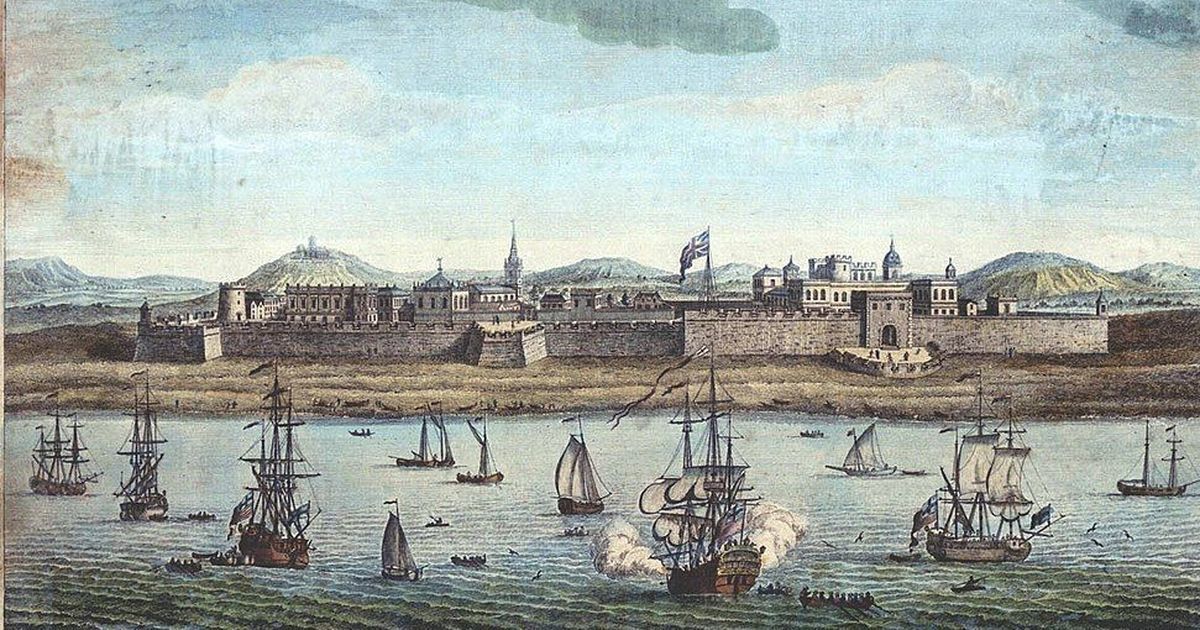 |
| East India Co. Fort St. George, Madras (Chennai,TN).scroll.in |
Above image" Fort St George, Madras early colonial time. Fort St George was, in origin, essentially a fort. The inner citadel was built in 1640, the outer wall and four bastions by 1659, primarily as protection from the “inland enemy”, variously Mughal generals, nawabs and the rulers of Golconda. Visitors approved of the fortifications’ height and thickness, however Andrew Cogan built it big when the Company’s stock was so small”. The Prospect of Fort St George was commissioned by Thomas Pitt, governor of Madras from 1698 to 1709, but was only completed after his death in 1726'' (https://scroll.in/article/867288/a-slice-of-history-what-a-british-city-plan-tells-us-about-)......................................
The EIC introduced certain new reforms in the existing revenue after getting a jagir from the Nawab of the Carnatic in 1763, the company aimed at taking more revenue for itself. Accordingly, Haliburton, the most powerful and influential member of the Board of Revenue, introduced a new system - warachittam, a new mode of revenue-collection, by which the Company could get more revenue than through the then existing system.
 |
| common-place-archives.org |
Above image: "The Rise of India Stock & sinking fund of oppression," engraving by B. W. (January 1784). Courtesy of the British Cartoon Collection, American Antiquarian Society, Worcester, Massachusetts..................
The natives and the merchants were not happy about this new system as they would lose a big chunk of revenue. They appealed to the Governor and leading merchants, like Kandappa Mudaliar, Sami Sungaraman Chetty, Ponnappa Mudali and Appaji Rao, sought Paupiah's help and bribed him to get the new revenue system of warachittam buried for ever. But Haliburton was resolute to get it introduced Suspecting blockage of resolution by Haliburton, Paupiah and the Holland brothers hatched a plot to remove Haliburton soon from the Board of Revenue. They framed up charges against him by instigating the natives to oppose the Company administration. Paupiah had several natives sent petitions against Haliburton to the Company. As there was enough evidence on hand EIC removed Haliburton from the Board of Revenue and posted him to Chandragiri as pay master, a post of no importance.
With the removal of Haliburton, the Holland brothers, in collusion with Paupiah, misappropriated huge amount in the later period. The cheating was so bad the notoriety of Paupiah became a byword in common parlance. In the wake of corrupt administration and continuous official misdeeds, the Holland brothers name was on the line. They became unpopular to such an extent Jon Holland had been relieved of the Governorship and Edward Holland was fired from the Board of Revenue, Reason: misappropriation of funds and amassing huge wealth through bribes. No sooner had William Medows become the new Governor than Haliburton appealed to him to constitute a commission in July 1792 to go into the bottom of the misdeeds done by the Holland brothers and his cronies including their Dubhasi Avadhanum Paupiah, and their his role in relieving him swindling both Government and private parties. The accomplices of Paupiah, Avadhanum Thangasami, his brother, Appayyangar, a relative, and Venkatacha Chetty admitted their roles before the Commission.
Paupiah was tried between 11 and 13 July 1792 for conspiracy against David Haliburton in the Court of Quarter Sessions presided over by Gov. Charles Medows assisted by three Justices of Peace. All four accused were sentenced to imprisonment and fine and were ordered to stand in the pillory for an hour. Paupiah was jailed for three years and fined £ 2000 in addition.
After Paupiah's release from the jail, his misfortune never stopped and now a commission of inquiry in 1808 by the govt. had found in Paupiah’s residence evidence to prove his role in a large number of forged bonds in the names of various Nawabs of the Carnatic in the country. The holders of the genuine bonds agitated for repayment of the value of the bonds. The committee found that Paupiah had swindled very large amount. Prosecution for forgery was instituted against Paupiah, but he passed away in 1809 before the trial prosecution.
The scheme was exposed by Lord Cornwallis, the Governor-General of India who unraveled the corrupt practices of the Hollands. The Hollands managed to escape and sail to England, but Paupiah was convicted along with three other Indians.
There is a street named after Paupiah in Choolai, Chennai where his popularity as a swindler remains etched today. There are many streets named after debhasis such as Thambu Chetty Street, Lingi Chetty Street, Sunga Raman Chetty Street in George Town and Pachiyappan Street in Chetput among others.Dubash is generally used to refer to a cheat or fraudulent person. Even today the word dubakoor is being frequently used as a slang in Tanil movies to refer to a cheat.
'Paupiah's trial' was the subject of a 1793 book of the same title by David Haliburton. Its co-author was Scottish writer Sir Walter Scott.
https://en.wikipedia.org/wiki/Avadhanum_Paupiahhttp://madrasmusings.com/Vol%2018%20No%2023/the-dubashes-of-olde-madras.html
http://www.common-place-archives.org/vol-09/no-04/forum/opal.shtml
Paupiah was tried between 11 and 13 July 1792 for conspiracy against David Haliburton in the Court of Quarter Sessions presided over by Gov. Charles Medows assisted by three Justices of Peace. All four accused were sentenced to imprisonment and fine and were ordered to stand in the pillory for an hour. Paupiah was jailed for three years and fined £ 2000 in addition.
After Paupiah's release from the jail, his misfortune never stopped and now a commission of inquiry in 1808 by the govt. had found in Paupiah’s residence evidence to prove his role in a large number of forged bonds in the names of various Nawabs of the Carnatic in the country. The holders of the genuine bonds agitated for repayment of the value of the bonds. The committee found that Paupiah had swindled very large amount. Prosecution for forgery was instituted against Paupiah, but he passed away in 1809 before the trial prosecution.
The scheme was exposed by Lord Cornwallis, the Governor-General of India who unraveled the corrupt practices of the Hollands. The Hollands managed to escape and sail to England, but Paupiah was convicted along with three other Indians.
There is a street named after Paupiah in Choolai, Chennai where his popularity as a swindler remains etched today. There are many streets named after debhasis such as Thambu Chetty Street, Lingi Chetty Street, Sunga Raman Chetty Street in George Town and Pachiyappan Street in Chetput among others.Dubash is generally used to refer to a cheat or fraudulent person. Even today the word dubakoor is being frequently used as a slang in Tanil movies to refer to a cheat.
'Paupiah's trial' was the subject of a 1793 book of the same title by David Haliburton. Its co-author was Scottish writer Sir Walter Scott.
https://en.wikipedia.org/wiki/Avadhanum_Paupiahhttp://madrasmusings.com/Vol%2018%20No%2023/the-dubashes-of-olde-madras.html
http://www.common-place-archives.org/vol-09/no-04/forum/opal.shtml


