 |
| Kailasa rock-cut temple, Ellora, MHspeakzeasy.wordpress.com |
 |
| 250BCE Barabar caves en.wikipedia.org |
 |
| Kailash Temple, Ellora cave 16 en.wikipedia.org |
 |
| Udayagiri and Khandagiri Caves, 2nd C BCE. Odisha en.wikipedia.org |
 |
| Ist C The Great Chaitya in the Karla Cave, MH en.wikipedia.org |
 |
| Badami cave templemysteryofindia.com |
 |
| Ajantha caves MH Cave 19, 5th-century en.wikipedia.org |
Worship of gods and goddesses has been around in the subcontinent for centuries. In the ancient period places of worship were in the interior places far removed from human habitation. Such places of worship were in the caves in the midst of wooded areas and they date back to 1st century CE. Obviously, Caves temples have long been considered as divine and sanctified where the devotees could engage in prayer and meditation in a quiet ambiance without any external or internal disturbance. The rock cut caves spread across India Maharashtra, Bihar, Odisha, Karnataka, Tamil Nadu and other states are repositories of not only the ancient civilization but also part of architectural and religious heritage of this country.
The caves are classified into two types - ''natural ones and man-made'' found in mountainous terrain in the forested areas. The Buddhist monks, saints and ascetics used them as places of worship and divinity and also as monasteries. Least to say such isolation and seclusion offered them a serene environment to carry on their spiritual activities and meditation. Endowed with innumerable natural mountainous terrains, India has the largest number of rock-cut caves and temples of amazing architecture, sizes and varieties in the world which no other country possesses.
Invariably, religion based such temples since the 3rd century had been functioned as a place of rest and relaxations - a sort of stop-over stop-over for the inter, intra and trans mercantile traders who chose specific trade routes to reach their destination. That the caves lie close to old trade routes corroborate this perception. they show the amalgamation of three religions -Hinduism, Buddhism and Jainism and caves at Ellora had long been used then and there by the saints in the past.
Over a period of time the cave temples with fine decoration and artistic work showed up and such man-made rock-cut temples met the expenses from donations from the travelers and rich merchants who would use them frequently. The retreats with facilities on the trade routes gave the wealthy traders the needed respite and they did not mind offering them monetary help.
Below are given are some of India's famous rock-cut temples that were built centuries ago, many of them before the arrival of Muslims rulers from NW and European Colonists. It was the Europeans in the 18th century ran into such amazing cave temple and published articles on them and consequently their popularity among the western world increased considerably. UNESCO way back in 1983 recognized both the Ajanta and Ellora caves as World Heritage Sites describing the the latter “a unique artistic creation and a technological exploit.” The Ellora caves site had been a center of religious and spiritual activities from 5th to the 11th centuries and it was patronized by many dynasties such as the Chalukyas, the Rashtrakutas, the Kalachuris and many others.
Here is the list of 15 most amazing rock cut caves in India:
01. Ajanta Caves, Maharashtra:
Top 15 Rock-Cut Caves: Ajanta Caves, India
|
| Ajantha caves MH Cave 19, 5th-century en.wikipedia.org |
 |
| Viharara, Ajantha caves MH en.wikipedia.org |
they were carved out of a solid rock along the Waghora River. Most of the rocks are of volcanic origin and they are of different kinds of .
 |
| Cave 4, Ajanta Cavesupload.wikimedia.org |
A World Heritage Site by listed by the UNESCO, it is also a protected monument under the ASI - Archeological Survey of India. The sculptures and and well carved artistic works of Ajanta caves highlight the heyday of Buddhism and Buddhist art in India.
Ajanta Caves were abandoned in AD 650 and were gradually forgotten until their ‘rediscovery’ by a British officer in 1819.
02. Ellora Caves, Maharashtra
Top 15 Rock-Cut Caves: Ellora Caves, India
 | ||
View from Cave 29, Ellora en.wikipedia.org.
|
The Ellora caves with 34 monasteries and temples located in Aurangabad district of Maharashtra are most famous. Included here are 12 Buddhist caves, 17 Hindu Caves (14 to 29 representing Hindu iconography) along with 5 caves dedicated to Jaina saints. Amazingly, the cave complex extends over 2 kilometers in a volcanic terrain made of basalt rocks (they are part of the Deccan plateau) . It is a world heritage site and one of most important ancient monuments in India dating back to between the 5th and 11th centuries AD patronized by many dynasties, including the Chalukyas, the Rashtrakutas, the Kalachuris and many others; however correct date is not yet fixed. Hence the caves show a blend of many different architectural and aesthetic elements showing the influences of various dynasties.
 |
| Cave 12, Ellora, a late multi-story rock-cut vihara.upload.wikimedia.org |
The Ellora caves like Ajantha contain many frescoes, reliefs, and shrines, including carvings of Buddha , bodhisattvas, and saints. In many cases the stone is intricately carved to look like wood. It is not only the largest rock-hewn monastic-temple complexes in the world, but also the largest single monolithic excavation in the world,
the great Kailasa temple.........
000
03. Elephanta Caves, Maharashtra:
Top 15 Rock-Cut Caves: Elephanta Caves, India
img source
 |
| Elephanta caves, Mumbai forum.xcitefun.net |
 |
| Elephanta caves, Mumbaiexpedia.com |
the collections include predominantly Hindu God Shiva (5 caves) The large monolithic 20 feet (6.1 m) sculptures of Trimurti Sadashiva (three-faced Shiva), Nataraja (Lord of dance) and Yogishvara (Lord of Yoga) being the most celebrated.
A UNESCO World Heritage Site the caves appear to date from 7th century. originally called Gharapuri (meaning "the city of caves"), the Portuguese renamed it Elephanta - ''Elefante'' as they ran into a large stone elephant near the place where they first landed. A few Buddhist stupa mounds date back to the 2nd century BCE, as well as a small group of two Buddhist caves with water tanks. Dating them between 5th and 9th century, various Hindu dynasties built the caves and the average date is: 6th century CE......
 |
| Elephanta caves, Mumbai. Main mandapa and pillars en.wikipedia.org |
Much of the art works are either damaged or defaced. The ideas of Hindu and Buddhist iconography, perhaps might have got inspiration from the sculptures that show a blend of Hindu and Buddhist concepts -syncretism. The rock caves are mostly made of basalt rock types. The credit goes to the British Raj who took a serious and a major step to stop damages to the monuments in 1909. The Archaeological Survey of India (ASI) is managing this site.....
Top 15 Rock-Cut Caves: Bhaja Caves, India
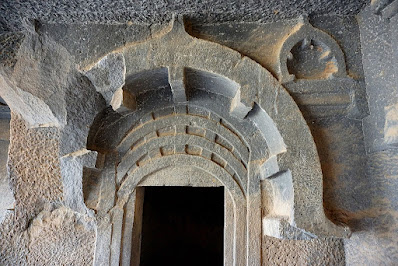 |
| Door archway, Bhaja Caves, Lonavala, Pune MH commons.wikimedia.org |
 |
| Bhaja caves, Maharastra mysteryofindia.com |
Dating back to the 2nd century BC this group of 22 rock-cut Bhaja caves located in Pune, near Lonavala, Maharashtra are found in steep basaltic cliff face 120 m above the surrounding plain, all facing the west.; very much similar to those at Ajanta and Karla.
 |
| Ribber Design Rafters, Bhaja Caves, commons.wikimedia.org |
 |
| Chaitya Hall, Bhaja Caves, Lonavala, commons.wikimedia.org |
The largest shrine is Chaitya Griha, a large prayer hall with a horseshoe-shaped entrance, mythological features and a stupa at one end. The group in the complex includes 14 stupas, five inside and nine outside an irregular excavation and a number of viharas that were used as residence by Buddhist monks who were also teachers of Buddhism. A branch of Buddhism that adheres to Pali scriptures and the nontheistic ideal of self-purification to nirvana was quite prevalent and was in its earliest phase when Mauryans were ruling part of north India. Dedicated to Lord Buddha throughout the caves, there are many nicely carved images of the Lord Buddha. The various artistic works on the cave walls symbolize the life of Buddha - carvings of lotus or elephant symbolic of his birth, mound, symbolic of his birth as a prince and death, bodhi tree - under which Lord Buddha got the ultimate enlightenment. The stupas in Bhaja caves are relics of resident monks with their names inscribed in them. They were theological teachers who died died there.
 |
| simple Vihara Bhaja Caves, Lonavala,Pune, MH commons.wikimedia.org |
 |
| Vihara Bhaja Caves, Lonavala, commons.wikimedia.org |
The interiors of rock cut caves are well planned as to allow the beam of light of the setting sun to light up the interior. Characteristic of elaborate sculptures with headdress, garlands, and jewelry, the carvings are not deep, almost similar to molded terracotta features.; the theme includes mythological tales. deities, etc. A fascinating feature is the display of tabla - playing woman sculpture, a famous Indian percussion instrument (dating back to 200 BCE).
Above images: Vihara, Bhaja caves- Vihāra commonly refers living quarters for monks with an open shared space or courtyard, particularly in Buddhism. It is Buddhist monastery and the Sanskrit word as in Pali texts, is meant any space or facilities for dwellings. In ancient rock-cut architecture of India, it means a central common hall, with small cells connected to it sometimes with carved stone beds. Some have a shrine cell set back at the centre of the back wall, containing a stupa in early examples, or a Buddha statue later. Rock-cut caves such as those in Ajanta Caves, Aurangabad Caves, Karli Caves, Bhaja caves near pune and Kanheri Caves contain several viharas. Some included a worship hall called chaitya The vihara provided a comfortable shelter for the wandering monks in ancient India during the monsoon rainy seasons.
 |
| Chaitya (monastic monument hall), Bhaja caves, Maharastra mysteryofindia.com |
Read more at: http://www.mysteryofindia.com/2015/03/bhaja-caves-rock-cut-buddhist-temples.html
000
05. Kanheri Caves, Maharashtra:
Top 15 Rock-Cut Caves: Kanheri Caves, India
img source
 |
| Kanhari cave prayer hall Chaitya hall with stupa, Cave 3en.wikipedia.org |
Kanheri Caves constitute a group 109 of rock-cut monuments located inside the Sanjay Gandhi National Park, north of Mumbai. Built between the 1st century BC and 9th century AD, the Kanheri Caves demonstrate the Buddhist influence on the art and culture of India and offer picnickers a getaway, especially during the rainy season.
 |
| Kanheri caves, Chaitya cave (cave No.3) en.wikipedia.org |
Majority of the caves are monasteries, intended for living, study and meditation. All of them have elaborately carved sculptures, relief’s and pillars and encompass rock-cut stupas for worship.
Kanheri Caves
Kānherī-guhāḥ
Kanheri Caves prayer hall.JPG
Chaitya hall with stupa, Cave 3
Map showing the location of Kanheri Caves Map showing the location of Kanheri Caves
Location Sanjay Gandhi National Park
Geology Basalt
Entrances 109
The Kanheri Caves (Kānherī-guhāḥ) are a group of caves and rock-cut monuments cut into a massive basalt outcrop in the forests of the Sanjay Gandhi National Park, on the island of Salsette in the western outskirts of Mumbai, India. They contain Buddhist sculptures and relief carvings, paintings and inscriptions, dating from the 1st century BCE to the 10th century CE. Kanheri comes from the Sanskrit Krishnagiri, which means black mountain.
The site is on a hillside, and is accessed via rock-cut steps. The cave complex comprises one hundred and nine caves, carved from the basalt rock and dating from the 1st century BCE to the 10th century CE. The oldest are relatively plain and unadorned, in contrast to later caves on the site, and the highly embellished Elephanta Caves of Mumbai. Each cave has a stone plinth that functioned as a bed. A congregation hall with huge stone pillars contains a stupa (a Buddhist shrine). Rock-cut channels above the caves fed rainwater into cisterns, which provided the complex with water.[3] Once the caves were converted to permanent monasteries, their walls were carved with intricate reliefs of Buddha and the Bodhisattvas. Kanheri had become an important Buddhist settlement on the Konkan coast by the 3rd century CE.
Most of the caves were Buddhist viharas, meant for living, studying, and meditating. The larger caves, which functioned as chaityas, or halls for congregational worship, are lined with intricately carved Buddhist sculptures, reliefs, pillars and rock-cut stupas. Avalokiteshvara is the most distinctive figure. The large number of viharas demonstrates there was a well organized establishment of Buddhist monks. This establishment was also connected with many trade centers, such as the ports of Sopara, Kalyan, Nasik, Paithan and Ujjain. Kanheri was a University center by the time the area was under the rule of the Mauryan and Kushan empires.[1] In the late 10th century, the Buddhist teacher Atisha (980–1054) came to the Krishnagiri Vihara to study Buddhist meditation under Rahul Gupta.
|
| Kanhari cave prayer hall Chaitya hall with stupa, Cave 3en.wikipedia.org |
06. Karla Caves, Maharashtra:
Top 15 Rock cut structures: Karla Caves
img source
Karla Caves are one of the ancient caves in Lonavala of Maharashtra that follow the mixed Hindu and Buddhists style of rock-carved caves architecture. The group at Karla consists of 16 rock cut excavations of which cave 8 is the chaitya griha which was carved during Satavahanas dynasty (271 BCE to 30 BCE).
 |
| Great Chaitya hall (worship) in the Karla Caves, MH. en.wikipedia.org |
Above image: Normally grand and solemn a chaitya hall, chaitya-griha, (Sanskrit: Caitya) is simply a prayer hall in a shrine invariably in Buddhist places of worship. It refer to a space with a stupa and a rounded apse at the end opposite the entrance, with a arched high roof; A religious architectural term in India the chaitya is the stupa itself and in Jainism and Hinduism it is a temple, sanctuary or any sacred monument. But in Buddhism practiced outside India, in countries like Cambodia, Nepal, etc it refers to the small stupa-like monuments. The curved ceiling with ribs imitate timber construction. The halls are commonly tall with curved roof , but narrow in width and the far end is the focus of attention parikrama. Going round the place of worship is part of worship ritual called prathashna . This is done around the Stupa or around the passage between columns on the sides
The horse-shoe shaped windows over the porch or the entrance itself allow enough light inside. In some places the hall is designed in such a way the opening overhead will allow the light to fall on the holy object or dagoba, but the rest is left in obscurity. As there are no openings on the sides the view between the columns that divide the aisles from the nave is unlimited. These caves are some of the largest rock-cut Buddhist shrines in India. The monasteries may belong to 60-40 B.C. and 4th century A.D.

The Karla Caves, Karli Caves, near Lonavala, Maharashtra. were developed from the 2nd century BC to the 5th century AD. The oldest is dated back to 160 BC, located on the major ancient trade route, running eastward from the Arabian Sea into the Deccan. The famous "Grand Chaitya" (Cave 8;120 CE), which is "the largest and most completely preserved" one with numerous fine medium-sized sculptures.
The caves at karli, near Lonavala and other places were developed through grants from Satavahana rulers and traveling traders. Buddhist chose the sites close to the trade route through their association with traders and knowledge of the mountainous terrains in this region.
A protected monument under the Archaeological Survey of India, the complex is being visited by lots of tourists. Further, such caves are located in picturesque hilly regions of Western Ghats.
https://en.wikipedia.org/wiki/Karla_Caves
000
000
11. Lenyadri Caves, Maharashtra
Top 15 Rock cut structures: Lenyadri Caves, India
img source
ooo

Lenyadri contains nearly 40 rock-cut caves. The best known and most visited is a group of 30 caves located in a compact group and all facing towards the south.
These caves have been created in the 1st – 3rd century AD as a Buddhist monastery. Later one of the Buddhist dwellings was turned into a popular shrine of Hindu god Ganesh. Lenyadri caves have preserved traces of ancient cave paintings and inscriptions.
14. Jogeshwari Caves, Maharashtra
Top 15 Rock cut structures: Jogeshwari Caves, India
img source
Dedicated to the Hindu god Shiva, the caves are estimated to be 1,500 years old and are some of the oldest cave temples in Mumbai. They are thought to be the work of Buddhist monks and Hindu priests, and they contain ornate sculptures.
The size of the cave complex rivals several UNESCO World Heritage sites nearby, such as the cave temples of Ajanta, Elephanta, and Ellora. These caves belongs to the last stage of the Mahayana Buddhist architecture.
ooo
15. Udayagiri Caves, Madhya Pradesh:
Top 15 Rock cut structures: Udaygiri caves, Madhya Pradesh, India
img source
The Udayagiri Caves feature some of the oldest Hindu cave temples. They were carved and completed under the patronage of Chandragupta II, Emperor of the Gupta Empire, in the late 4th and 5th century CE. The complex consists of twenty caves, of which one is dedicated to Jainism and all others to Hinduism.
iiiiiiiiii
The Kailasa rock-cut temple:
Top 15 Rock cut structures: Udaygiri caves, Madhya Pradesh, India
img source
The Udayagiri Caves feature some of the oldest Hindu cave temples. They were carved and completed under the patronage of Chandragupta II, Emperor of the Gupta Empire, in the late 4th and 5th century CE. The complex consists of twenty caves, of which one is dedicated to Jainism and all others to Hinduism.
iiiiiiiiii
 |
| Kailasa rock-cut temple, Ellora, MH speakzeasy.wordpress.com |
|
| Kailasa rock-cut temple, Ellora, MH speakzeasy.wordpress.com |
Bottom image: The Kailasa (Sanskrit : KAILASANATHA) Temple is one of the largest rock-cut ancient Hindu temples located in Ellora, Maharashtra, India.
It is a major attraction in Marathwada region of Maharashtra. It was built in the 8th century by the Rashtrakuta King Krishna -1 as attested in Kannada inscriptions.
This is one of the 34 temples and monasteries known collectively as Ellora caves. These extend over more than 2km, and were dug side by side in a wall of a high basalt cliff in the complex located at Ellora. The Kailasa (Cave – 16) is a remarkable example of Dravidian architecture on account of its striking proportion, elaborated workmanship, architectural content and sculptural ornamentation of rock-cut architecture
Top image" A rock bridge connects the NANDI MANDAPA to the porch of the temple. The structure itself is —— a tall South Indian temple. The shrine —- complete with pillars, windows, inner and outer rooms, gathering halls and an enormous stone LINGAM at its heart —— is carved with niches, plasters, windows as well as images of Deities, MITHUNAS (erotic male and female figures) and other figures. Most of the Deities on the left of the entrance are SHAIA is carved with niches, plasters, windows as well as images of Deities, MITHUNAS (erotic male and female figures) and other figures. Most of the Deities on the left of the entrance are SHAIAITE (followers of Lord Shiva), while on the right side the Deities are VAISHNAVAITES (followers of Lord Vishnu).
Kailasa temple pillar architecture
There are two DHWAJASTHAMBHA (pillars with flagstaff) in the courtyard. The grand sculpture of RAVANA attempting to lift Mount Kailasa, with his full might is a landmark in Indian art. ——- The Ellora complex is a unique artistic creation and a technological exploit, but with its sanctuaries devoted to Buddhism, Hinduism and Jainism, it illustrates the “spirit of tolerance” that was characteristic of ancient India.
Kailasa-Temple-Ellora -One of India’s most important archaeological sites from the Gupta period, it is currently a tourist site under the protection of the Archaeological Survey of India.
Posted in: Ancient Place, Featured, Top Lists Tagged in: Architecture, Bihar, Buddhist Caves, Cave, Madhya Pradesh, Maharashtra, Rock Art, Tamil Nadu
ooo
Trichy rockfort temple:
It is a major attraction in Marathwada region of Maharashtra. It was built in the 8th century by the Rashtrakuta King Krishna -1 as attested in Kannada inscriptions.
This is one of the 34 temples and monasteries known collectively as Ellora caves. These extend over more than 2km, and were dug side by side in a wall of a high basalt cliff in the complex located at Ellora. The Kailasa (Cave – 16) is a remarkable example of Dravidian architecture on account of its striking proportion, elaborated workmanship, architectural content and sculptural ornamentation of rock-cut architecture
Top image" A rock bridge connects the NANDI MANDAPA to the porch of the temple. The structure itself is —— a tall South Indian temple. The shrine —- complete with pillars, windows, inner and outer rooms, gathering halls and an enormous stone LINGAM at its heart —— is carved with niches, plasters, windows as well as images of Deities, MITHUNAS (erotic male and female figures) and other figures. Most of the Deities on the left of the entrance are SHAIA is carved with niches, plasters, windows as well as images of Deities, MITHUNAS (erotic male and female figures) and other figures. Most of the Deities on the left of the entrance are SHAIAITE (followers of Lord Shiva), while on the right side the Deities are VAISHNAVAITES (followers of Lord Vishnu).
Kailasa temple pillar architecture
There are two DHWAJASTHAMBHA (pillars with flagstaff) in the courtyard. The grand sculpture of RAVANA attempting to lift Mount Kailasa, with his full might is a landmark in Indian art. ——- The Ellora complex is a unique artistic creation and a technological exploit, but with its sanctuaries devoted to Buddhism, Hinduism and Jainism, it illustrates the “spirit of tolerance” that was characteristic of ancient India.
Kailasa-Temple-Ellora -One of India’s most important archaeological sites from the Gupta period, it is currently a tourist site under the protection of the Archaeological Survey of India.
Posted in: Ancient Place, Featured, Top Lists Tagged in: Architecture, Bihar, Buddhist Caves, Cave, Madhya Pradesh, Maharashtra, Rock Art, Tamil Nadu
ooo
Trichy rockfort temple:


