The annual chariot festival, or Therottam (தேரோட்டம்) as it is locally known in Tamil Nadu, represents one of the most spectacular, immersive, and enduring spectacles of Hindu temple traditions. While Rath Yatras are celebrated across India—most famously at the Jagannath Temple in Puri, Odisha—the southern state of Tamil Nadu boasts a dense network of massive wooden temple cars (rathas or thers /chariots) that serve as mobile replicas of the cosmos. Commonly held during the annual Brahmotsavam festivities, these festivals transform entire towns into vibrant hubs of communal devotion.
 |
| South India Hindu Temple Chariot instagram.com |
1. The Architectural Mirror: Religious & Cultural Significance
In Hindu temple architecture, a temple is not merely a building; it is a physical manifestation of the divine cosmos and the human body. The permanent structure moves from the wide outer corridors (prakaras) to the deep, silent, cave-like sanctum sanctorum (garbhagriha), simulating a journey from external distraction to internal spiritual awakening.


Above image: The Car of Juggernaut, as depicted in the 1851 Illustrated London Reading Book.........

When the festival season arrives, this structural philosophy is transferred onto wheels.
The Cosmos in Motion
The ratha acts as a moving temple (Chala Alayam). It carries the utchavars (the processional bronze deities) out of their dark, secluded sanctuaries directly into the public sphere. This transition carries profound theological weight:
Universal Accessibility: In historical contexts where access to the inner sanctum was restricted, the chariot festival democratized worship. The deity stepped out onto the Ratha Veethis (chariot streets) to bless every devotee, regardless of social standing.
 |
| Wooden Chariot Base Bangalore (Ulsoor) en.wikepedia.org |
The Chariot as the Body: According to Vedic philosophy, the chariot represents the human body, the horses represent the senses, and the deity inside represents the Atman (the soul) guided by the Divine.
The Philosophy of the Journey: The word Ratha stems from Sanskrit, meaning "to move." Whether it is a short, clockwise journey around the temple walls or a long-distance procession across town, pulling the thick jute ropes represents a collective surrender, erasing individual egos as thousands pull in unison.
2. Evolution Across the Centuries
The architecture of the temple car has evolved from simple wooden carts mentioned in early Sangam literature to multi-tiered, highly engineered structural wonders.
Early Roots (7th – 9th Century CE): Monolithic rock-cut temples like the Pancha Rathas at Mahabalipuram served as early architectural models for mobile chariots.
 |
| Pancha Rathas (Arjuna Ratha) Mahabalipuram en.wikipedia.org |

Above images: Pancha Rathas is an example of monolithic Indian rock-cut architecture. The complex was initially thought to have carved during the reign of King Narasimhavarman I (630–668 CE)and Narasimhavarman II (690- 725 CE). The site is part of the UNESCO World Heritage Site inscribed by UNESCO in 1984 as Group of Monuments at Mahabalipuram close to Chennai city.............
Medieval Grandeur (10th – 13th Century CE): Under the Medieval Cholas, stone temples grew to towering proportions, and wooden thers mirrored this vertical expansion. Complex iconography was carved into the wooden bases to document socio-religious narratives.
 |
| Airavatesvara temple, hall (mandapa) image:M. Jagadeesan en.wikipedia.org |
Above image: The Airavatesvara temple (completed in 1166 CE) Chala Emperor Rajaraja Chola II is part of popular UNESCO World Heritage Site inscribed as Living Chola Temples. It is near the temple city of Kumbakonam of Tamil Nadu ..............

Above image: Airavatesvara temple,Pateeswaram,TN.Chariot details;front legs of the horse are damaged.
 |
| Stone chariot temple of Humpi,Karnataka state karnataka.com |
Structural Maturity (16th Century – Present): The Vijayanagar and Nayak rulers added heavy reinforcement, expanding the physical footprint of the wheels and introducing iron axles. Modern conservation efforts have incorporated advanced elements, such as custom hydraulic braking systems and steel reinforcements, to ensure the safety of the lakhs of devotees who gather to pull them.
3. Profiles of Grandeur: Prominent Chariots of Tamil Nadu
Tamil Nadu features some of the largest and most intricately designed temple chariots in Asia. The table below outlines the primary specifications and features of the state's most iconic thers (chariots).
The chariot is like a moving temple carrying the presiding divinity of a particular temple and its configuration is almost like a temple; temple worship being part of our cultural ethos, a preponderance of Hindus will get involved in such temple festivities. A structure of the temple is like a cave temple of the earliest period and the ardent devotees have to go deep into it to reach the sanctuary - sanctum which is a sanctified place. The tower above it represents vertical dimension suggestive of the ascent to enlightenment and deliverance or salvation. The core of the temple is garbhagriha just like a mother's womb where the ambience is quiet and conducive to spiritual awakening because there is no distraction there for the devotee to focus himself on God.
The word 'Ratha' is of Sanskrit origin meaning to ''move'' and chariot, refers to the 'vehicle for movement'. It has been tradition to run the chariot around the temple as in many temples of Tamil Nadu or to a particular destination as in the case of Puri Jagannath temple from the main temple to Gudicha and back. This ritualistic religious journey is called rath yatra often accompanied by music, dances, chanting of god's name or mantra etc. In some temples it may be a short journey and the small chariot will be pulled along the four prakara clock-wise round the garbhagriha.
The State of Tamil Nadu features some of the largest and most intricately designed temple chariots in Asia. The table below outlines the primary specifications and features of the state's most iconic thers.
.jpg) |
| Varadaraja perumal temple, kanchi. upload.wikimedia.org |
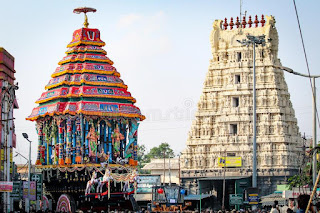 |
| Varadaraja perumal temple, kanchi.dreamstime.com |
Varadharaja Perumal Temple of Kanchipuram, TN dedicated to Vishnu is a famous Vaishnavite temple in this state. One of the 108 Divya Desam shrines (the fourth of the Divya Desams) believed have been visited by the 12 Tamil Vaishnava saints or Azhwars, it is a highly sanctified place because one of the greatest Hindu scholars of Vaishnava (Vishishtadvaita) philosophy, Sri Ramanuja is believed to have resided in this temple. Commonly known as: ''Perumal Koil', it is one of the most sacred places for Vaishnavites. Vaishnavites believe completion of 4 divyadesam shrines including the one a Melkote (Thirunarayanapuram), Karnataka without any break will assure the devotee an eternal place of rest in paramapadam in the shadow of the lord
As for the ther festival an eleven day event - of this temple, it falls in the month of may every year and the chariot festival is a popular one attended by lakhs of devotees. This year this event took place on
May 20th(festival began on 13th march. Garudaseva took place on the 15th of May.
https://en.wikipedia.org/wiki/Varadharaja_Perumal_Temple,_Kanchipuram
ooo
 |
| Sarangapani temple, Kumbakonam, TN. flickr.com/ |


 |
| Giant wheel of Ratha,Sarangapani temple, Kumbakonam. divinetraveller.net |
 |
| Sarangapani temple, chariot en.wikipeda.org |
Above image: Sarangapani Temple (Vishnu), Kumbakonam, Tamil Nadu is one of the Divya Desam shrines and also one of the Pancharanga Kshetram. several rulers had built this old temple
at different times from Medieval Cholas, Vijayanagar Empire and Madurai Nayaks. Some portions of the temple are dated to the 7th CE. The temple is enshrined within a huge granite wall and The temple complex that is enclosed within huge granite walls has many shrines and water tanks. The Rajagopuram (the main gateway) with 11 tiers is one of the tallest divyadesam shrine (ht:173 ft (53 m). The lord worshipped as Aravamudhan (unsatiating nectar), is seen reclining on serpent Adisesha with the left hand below the head and shoulders slightly raised. This pose is called Utthana Sayana. When inquisitive Thirumazhisai Azhwar questioned the lord whether his sleeping posture was due to over exertion. Upon this, it is believed, that the Lord slightly raised his posture to greet the saint. The processional idol is Sarangapani.
The temple has twin temple chariots weighing 300 (660,000 lb) each - 3rd largest in Tamil Nadu. As for its size size the chariots are next only to the ones in Thyagaraja temple in Thiruvarur and Andal Temple in Srivilliputhur and they were given a new lease of life and renovated in 2007. The chariots were not used for some years prior to that period. Here, the therottam takes place twice a year - during the Brahmotsavam in April–May and Rathasapthami in January–February. The wooden part of the chariot has nice carvings from the Hindu mythology. The attributes of Narasimha are well represented on the wood.
ooo
Adi Kumbeswarar Temple of Kumbakonam
 |
| Kumbeswarar temple, Kumbakonam. upload.wikimedia.org |
Above image: Adi Kumbeswarar Temple of Kumbakonam is a popular one closely associated with the Mahamaham temple tank here. In the form of a lingam, Shiva is referred to as Adi Kumbeswarar; his consort is Mangalambigai Amman. The presiding deity is revered in the 7th century Tamil Saiva canonical work, the Tevaram, written by Tamil saint poets known as the Nayanmars and Classified as Paadal Petra Sthalam the temple is dated back to the 7th century. Covering an area of 30,181 sq ft (2,803.9 m2) and houses four gateway towers, the temple has many pillared halls built by the Vijayanagara rulers. The temple has five chariots of various sizes and the car festival takes place as part of annual Maasimaham celebrations (February - March). Besides main deities, gods Subramaniam, Ganapathy and Chandikeswarar will be taken on the chariot as part of the religious procession...........
 |
| Tharangambadi, TN Car festival procession. samlinger.natmus.dk |
Brihadishwara Temple, Thanjavur:
 |
| 1010 year old Brihadeeswara temple, Thanjavur, TN.commons.wikimedia.org/ |
 |
| Thanjavur Big temple chariot, near the the shed. hindu.com |
Above image: Brihadishwara Temple Chariot. Thanjavur. A UNESCO Heritage Site, more than 1010 years old it was built by Raja Raja Chola I. Lord's consort is Bragannayaki. The last chariot festival of the Big Temple was held in 1818. Later it was not held due to paucity of funds during the early colonial period. The new chariot is 50 foot tall (when decked-up) and weighs 40 tons with 231 wooden icons and 245 bells. After a lapse of 100 years it first ran on 29th April 2015. The credit goes to the Late CM J. Jayalalithaa and her team of ministers.
http://www.thehindu.com/features/friday-review/watching-temple-chariot-is-an-aweinspiring-experience/article6245119.ece
https://en.wikipedia.org/wiki/Temple_car
http://navrangindia.blogspot.in/2015/02/largest-towering-temple-chariot-rath-of.html
https://www.pramanaresearch.org/gallery/prj-p289.pdf
https://en.wikipedia.org/wiki/Temple_car
http://navrangindia.blogspot.in/2015/02/largest-towering-temple-chariot-rath-of.html
https://www.pramanaresearch.org/gallery/prj-p289.pdf
K. N. Jayaraman (Author: navrangindia.blogspot.com )


