Lady Charlotte Canning (1817–1861), wife of Charles Canning, the last Governor-General and first
Viceroy of India, occupies a unique place in colonial history. Known for her artistic talent, refined sensibility, and charitable disposition, she was also an accomplished landscape painter who frequently sketched the Hooghly riverbanks and the gardens of Barrackpore. Her untimely death on 18 November 1861, after
contracting malaria during a journey from
Darjeeling, deeply affected the British community in India.
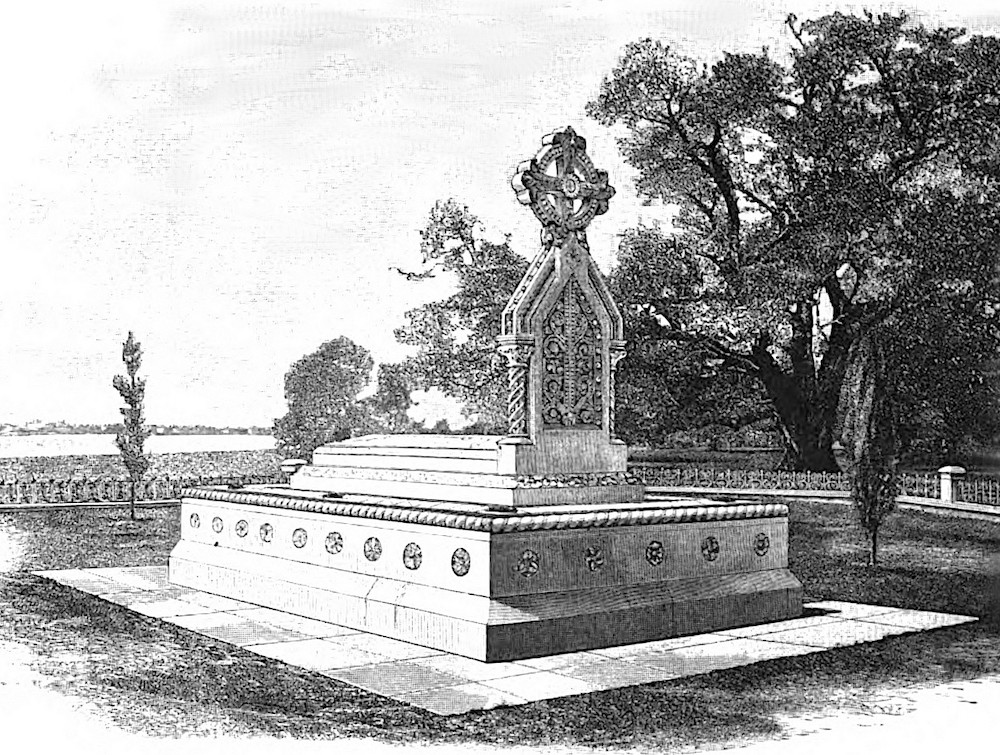
Above image: Lady Canning's monument, Barrackpore, WB. Image source: Hare, III:facing p. 168. Note the iron railings. On the other side of the headstone (as seen top right) is the text, "I will ransom them from the power of the grave," from Hosea 13, 14. Philip Davies noted in the 1980s that the inlaid marble was "pitted by the monsoon rains" .............
.jpg) |
Tomb of Lady Canning, Barrackpore',
1925.Alamy.com
|
Initially, Lady Canning was buried in the garden of the Governor-General’s country residence at Barrackpore, a place she had lovingly nurtured. Lord Canning chose the site deliberately, describing Calcutta’s cemeteries as “odious in many ways” and preferring the serene riverside retreat she cherished. Later, when a permanent memorial was completed, her remains were moved. In 1913, the tomb was relocated to the north colonnade of St. John's Church, one of Kolkata’s oldest Anglican churches and a repository of colonial memorials.
The monument was designed by the eminent
Gothic Revival architect George Gilbert Scott, with sculptural work by John Birnie Philip. Executed in richly carved and inlaid marble, the memorial reflects
high Victorian funerary aesthetics. Delicate floral motifs, ornamental tracery, and symbolic Christian iconography adorn the structure. An inscription composed by Lord Canning expresses profound personal grief and faith, emphasizing her humility, charity, and devotion. Biblical lines, including “I will ransom them from the power of the grave” (
Hosea 13:14), reinforce its spiritual tone.
A replica of the monument, without intricate marble inlay, remains at Barrackpore. In 2013, the
Barrackpore Government House was officially listed as a heritage structure by the West Bengal government, and the West Bengal Heritage Commission has since undertaken commemorative efforts to preserve its historical associations.
Lord Canning wrote. ''Since the cemeteries in Kolkata were “odious in many ways” ..It is a beautiful spot, looking upon that reach of the grand river which she was so fond of drawing, shaded from the glare of the Sun by high trees and amongst the bright shrubs and flowers in which she had so much pleasure.”
Today, Lady Canning’s tomb at St. John’s stands in relatively stable condition, though earlier observers noted weathering of its marble surfaces due to monsoon exposure. As part of Kolkata’s layered colonial landscape, the monument serves not merely as a personal memorial but as a reflection of imperial sentiment, Victorian artistry, and the intimate human dimensions of British rule in India.
K. N. Jayaraman



.jpg)