 |
| Prince Albert Edward in.pinterest.com |
The tour was both diplomatic and symbolic. It aimed to reinforce bonds between the British Crown and India’s princely states on the eve of Queen Victoria’s proclamation as Empress of India in 1876. At numerous royal courts, the Prince witnessed the magnificence of Indian ceremonial traditions and engaged directly with rulers, nobles and religious leaders. These encounters were governed by established protocol, under which Indian rulers presented gifts worthy of the Prince’s rank and imperial standing.
In total, Prince Albert Edward received nearly 2,000 gifts, each reflecting regional artistry, cultural identity and technical excellence. These objects—ranging from weapons and jewelry to ceremonial vessels and courtly curios—were not merely lavish offerings but carefully selected symbols of loyalty and prestige. Their craftsmanship was of such high quality that many were considered impossible to replicate. Between 1876 and 1883, the Prince of Wales’s Indian Collection toured Britain and Europe, attracting over 700,000 visitors and shaping European perceptions of Indian art.
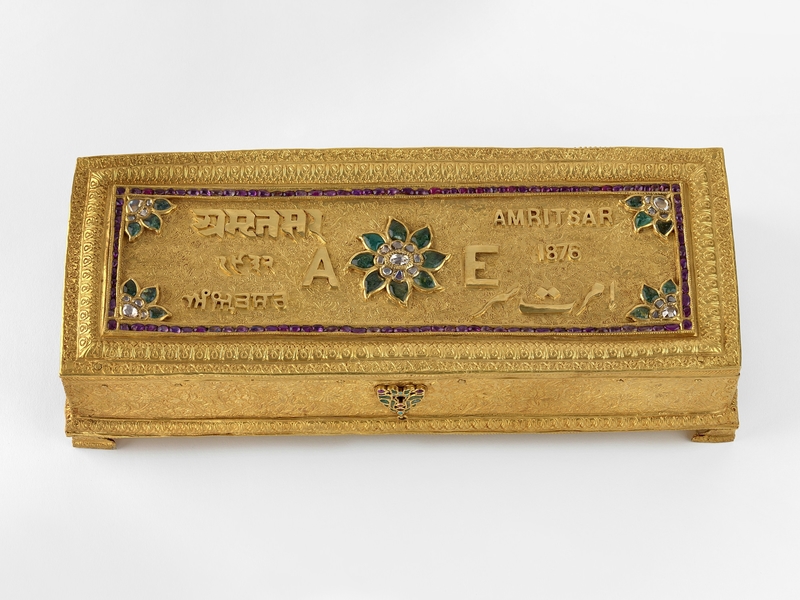
Among the most notable gifts was an ornate casket from Amritsar, jointly presented by Sikh, Muslim and Hindu communities, bearing inscriptions of “A E” (Albert Edward) in English, Gurmukhi, Urdu and Devanagari—a rare expression of communal unity. South India contributed finely worked weapons, including spearheads and daggers decorated with Hindu iconography such as the ten avatars of Vishnu. A ceremonial pichangatti knife from Coorg, unusually fashioned with a silver blade, highlighted regional traditions of personal adornment.
Luxury objects further showcased India’s artistic brilliance. Jaipur’s renowned enameling tradition was represented by exquisitely decorated bottles and salvers, while Trichinopoly goldsmiths supplied sculptural jewelry such as bangles adorned with mythical makara motifs. A pair of paan boxes from Indore illustrated the cultural importance of betel-leaf rituals at courtly gatherings, and rosewater sprinklers from the Nahan Foundry demonstrated the adaptation of industrial workshops to ceremonial artistry.
In 2017, after a gap of 130 years, a selection of these gifts was exhibited in Scotland at The Queen’s Gallery, Palace of Holyroodhouse, as part of the UK–India Year of Culture. Today, preserved in the Royal Collection, these gifts stand as enduring testimonies to India’s rich artistic heritage and the complex cultural diplomacy of the British imperial era.
 |
| India, casket. alaintruong.com |
This casket with its inscription of ‘A E’ stands for Albert Edward in English, Gurmukhi, Urdu and Devanagar. It i was presented jointly on behalf of the Sikh, Muslim and Hindu communities when the Prince visited the city. The Prince also visited the Harmindar Sahib or Golden Temple, the principal Sikh holy temple completed in 1604.
 |
| South India. Spearhead. alaintruong.com |
Above image: South Indian. Spearhead, 7th century. Steel, 49.5 x 7.4 x 7.5 cm , Royal Collection Trust 2017...........
 |
| S. India. Dagger and scabbardalaintruong.com |
Above image: South India. Dagger and scabbard, 1800-75. Watered crucible steel, gold, ivory, wood, velvet, diamonds, 37.2 x 12.7 x 5.0 cm, Royal Collection Trust 2017...........
The scabbard mounts have been adapted for presentation with the addition of the Prince of Wales’s feather
 |
| India. Knife and sheath, alaintruong.com. |
 |
| India. rosewater sprinklers,alaintruong.com |
Above image: Nahan Foundry. Pair of rosewater sprinklers, 1873-76. Silver, 37 x 10.7 cm ( Royal Collection Trust 2017................
The Raja of Nahan founded the Nahan Foundry in 1873. The foundry usually produced industrial objects such as sugar-cane crushers and railings, but as a gift for the Prince made these sprinklers that are supposedly automatic. However the pump mechanism seen at the base of the sprinkler’s neck is not functional.
 |
| S. India, Gold bangle with rubies. alaintruong.com |
Above image: South India. Bangle, circa 1850 - 1875. Gold and rubies, 3.3 x 8.8 x 8.8 cm , Royal Collection Trust / © HM Queen Elizabeth II 2017..................
The Prince purchased this bangle depicting heads of makara (mythical sea creatures), the two largest heads being inlaid with ruby eyes. The Prince purchased this bangle from a peddler, referred to as ‘boxwallah’ in William Howard Russell’s diary, and presented it to Queen Victoria as a birthday present.
 |
| India, necklace - gold, diamond, etc. alaintruong.com |
Above image: Indian. Necklace, circa 1800 - 1878. Gold, enamel, diamonds, rubies, pearls and emeralds; 22.6 x 15.5 x 0.7 cm , Royal Collection Trust / © HM Queen Elizabeth II 2017...............
 |
| India, Bottle and salver, alaintruong.com |
Above image: Indian. Bottle and salver, circa 1870 - 1875. Gold, enamel, diamonds and a ruby; 26.5 x 18.8 x 18.8 cm, Royal Collection Trust / © HM Queen Elizabeth II 2017.......................
Jaipur was a well-known centre for polychrome enameling. This enameled bottle and salver of remarkable quality showcases the skill and precision of the enameler.
 |
| India Paan Box,, Indore.alaintruong.com |
Paan or betel-leaf chewing is common across India and is part of the culture among Hindus and also muslims. Paan is a mixture of ingredients such as shavings of betel nut (a mild stimulant with similar effects to caffeine), seeds, coconut and occasionally tobacco wrapped in a betel leaf, which was offered at the end of formal court gatherings. The individual hinged covers are designed to store the various ingredients used to prepare paan. The compartments are in the shape of betel leaves.
http://www.alaintruong.com/archives/2017/12/17/35965101.html


