1. Imperial Crown of Bahadur Shah II (Last Mughal Emperor)
 |
| Mogul king and the crown msn.com |
 |
| Part of Last Mogul rule's crown Facebook.com |
 |
| Crown of Last Mogul ruler Bahadur Shah Zafar. me.me |
 |
| Crown of Bahadur Shah rarebooksocietyofindia.org |
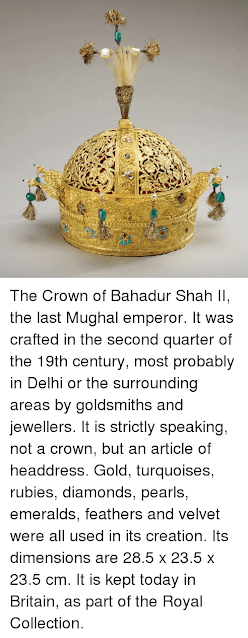
Above images: This is the image of a crown worn by the last Mogul ruler Emperor Bahadur Shah II till 1857; it included gold wire embroidery turquoises, rubies, diamonds, pearls, emeralds, feathers and velvet. height 16.4cm; diam. 17.7cm. In 1861, Queen Victoria purchased
Date: Early–mid 19th century
Materials: Gold wire embroidery, turquoises, rubies, diamonds, pearls, emeralds, velvet, feathers
Dimensions: Height 16.4 cm; Diameter 17.7 cm
Provenance: Red Fort (Qila-e-Mubarak), Delhi; acquired by Major Robert Tytler during the aftermath of the Siege of Delhi (1857). Purchased by Queen Victoria, 1861.
Description:
This ceremonial crown was worn by Emperor Bahadur Shah II, the last sovereign of the Mughal Empire, and represents the final phase of Mughal courtly aesthetics. Constructed on a velvet base and richly overlaid with gold wire embroidery, the crown incorporates an array of precious stones—turquoises, rubies, diamonds, pearls, and emeralds—arranged in traditional Mughal patterns. A plume of feathers, once emblematic of imperial dignity and divine sanction, rises from the front.
The crown blends Persianate and Central Asian imperial elements with late Mughal craftsmanship. Unlike earlier, more elaborate Timurid-style diadems, this example is compact and intended for wear over a turban, possibly during formal audiences or state ceremonies.
Historical Context:
The crown was seized by British forces following the suppression of the 1857 uprising. In 1860, Army officer Major Robert Tytler transported the crown to Britain, where it was inspected by Queen Victoria at Windsor Castle. It was officially purchased in January 1861 and entered the Royal Collection. The object symbolizes legacy of Mogul rule, enduring craftsmanship of the late Mughal court and the abrupt collapse of the dynasty after three centuries of rule.
2. Throne Chairs of Bahadur Shah II (Pair)
 |
| Bahadur Shah's throne facebook.com |
Date: Mid 19th century
Materials: Wood, gilt decoration, velvet upholstery, precious stone inlay (traces present)
Provenance: Red Fort, Delhi; acquired by Major Robert Tytler after the Siege of Delhi; purchased by Queen Victoria in 1861.
Description:
This pair of throne chairs is believed to have formed part of the formal seating used in the Diwan-i-Khas (Hall of Private Audience) or within other ceremonial chambers of the Mughal palace in Delhi. The chairs exhibit late Mughal court design: carved wooden frames with gilt surfaces, gently flaring legs, and deep red velvet upholstery. Although now largely stripped of jewels, contemporary accounts confirm that the chairs were originally set with decorative stones and gold accents, reflecting the elevated status of the emperor.
Their stylistic features—arched backs, floral gilding, and symmetrical ornamentation—echo the refined aesthetics cultivated during the declining years of the Mughal Empire.
Historical Context:
Following the British reoccupation of Delhi in September 1857, palace furnishings and royal objects were widely plundered. Major Robert Tytler secured these throne chairs and took them to Britain. The objects were later presented to Queen Victoria along with the emperor’s crown. Today, the chairs Though a jeweler offered 1000 pounds for the artifacts of a vanished imperial world, bearing silent witness to the upheaval that ended Mughal sovereignty, Tyler finally presented them to the Queen considering their historical value. Now they are par of the Royal Collection in London.
https://navrangindia.blogspot.com/2022/02/stolen-treasures-of-india-crown-of.html
.jpg)


