 |
| google.com |
 |
| shooting Inspector Simpson,Kolkata. google.com |
 |
| Dinesh Gupta. en.wikipedia.org |
 |
| SlidePlayer |
 |
| Writer's bldg Kolkata Simpson was shot google.com |
 |
| Memory of martyrdom Writer's building, Kolkata |
 |
| Statues of Dinesh, Badal and Basu, Kolkata google.com |
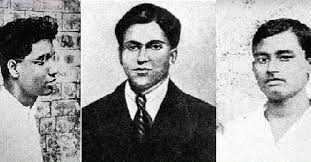 |
| Benoy Badal Dinesh google.com |
Born on 6 December 1911 in Josholong in Munshiganj District, now in Bangladesh, Dinesh Gupta, as a student in a Dhaka College, joined Bengal Volunteers. This group was organized and led by a great freedom fighter of exceptional ability Subhash Chandra Bose in 1928, at a time when Calcutta session of the Indian National Congress meeting was on. Driven by patriotic zeal and keen desire to free India, more volunteers joined this group and it became an active revolutionary association . At the outset, they wanted to get rid of those infamous British police officers whose attitude toward Indian natives was unbearable. Dinesh Gupta was in Midnapore town undergoing training with local revolutionaries in the use of firearms. Revolutionaries who imparted training to him were responsible for the assassination of three District Magistrates in succession, Douglas, Burge, and Peddy.
In Calcutta, Col NS Simpson, the Inspector General of Prisons, attained notoriety for his brutal oppression of Indian prisoners in the jails. His treatment of Indian prisoners with brute forces dismayed countless Indian leaders. The association of revolutionaries, having come to the fag end, decided to zoom in on Col NS Simpson and get him out of the way. They thought by launching an attack on the Secretariat Building - the Writers' Building in the Dalhousie Square in Kolkata and the elimination of a high British official like Simpson would strike a terror in the British official circles.
Dressed in European costume, on 8 December 1930 Dinesh, along with Benoy Basu and Badal Gupta, entered the Writers' Building and shot dead Simpson. In the aftermath there ensued a brief gun fight between the youth and the police. Some other officers like Twynam, Prentice and Nelson, during the gun battle suffered injuries. At last, the police overpowered the young revolutionaries and pinned them down. The youths, as it was there intention not to be caught by the police and be hanged, decided to kill themselves. Badal Gupta took Potassium cyanide while Benoy and Dinesh, in a jiffy, shot themselves with their own revolvers. Benoy was taken to the hospital where he died on 13 December 1930. Among the trio, Dinesh survived the near-fatal injury. He was convicted by the court and sentenced to death.
Dinesh was sent to Alipore jail where he was hanged to death on 7 July 1931. Before his sentence, from the condemned cell Dinesh wrote as many as 92 letters to his sister which were later compiled into a book 'Ami Shubhash Bolchhi'.
Soon after this incident in which all the three revolutionaries were dead for the sake of their motherland, Kanailal Bhattacharjee., another patriot and freedom fighter became a vigilante and took revenge for the hanging by killing on 27 July 1931 Mr. Gerlick, the British judge who presided over the Simpson Murder case and who sentenced Dinesh to death. At the Alipore Central jail Dinesh did not keep quiet. He translated a short story of Anton Chekhov which was published in Prabasi Magazine.
All the three youths - Benoy, Badal, and Dinesh became martyrs in Bengal and other parts of India. After independence in August 1947, Dalhousie Square was named B.B.D. Bagh - after the Benoy-Badal-Dinesh trio. Further, to honor their bravery and in memory of their attack on the writers' building, Calcutta a plate was engraved in the wall of the building's first floor.


